
 Waly Salomão | B-A-B-I-L-A-Q-U-E-S
 Waly Salomão | B-A-B-I-L-A-Q-U-E-S
 Waly Salomão | B-A-B-I-L-A-Q-U-E-S
 Waly Salomão | B-A-B-I-L-A-Q-U-E-S
 Waly Salomão | B-A-B-I-L-A-Q-U-E-S
Waly Salomão
From Oct 29 to Dec 18 2009
The twenty series of photographs called Babilaques made by Waly Salomão in New York, Rio de Janeiro and Salvador, from 1975 to 1977, exemplify a rare and startling kinship between poetry and art. It now seems surprising that they were neither directed towards, nor absorbed by the visual arts circuit of the day, remaining largely unknown by poets and the literary world. However, when we consider how strongly Waly Salomão affirmed and defended the significance of his own creative process in poetry, which he revealed insistently in defining as a sinuous, oblique, meandering, and polysemic path; it was not altogether unpredictable that such should have been the case.
Brought to light for the first time in the exhibition Babilaques: alguns cristais clivados [Babilaques: a few cleaved crystals], this little known part of his work, the spelling of which (B-A-B-I-L-A-Q-U-E-S) he used and drew with great relish in order to emphasize the meaning of the images produced, now gives us an opportunity to recall the highly erudite poet who both acknowledged and incorporated examples of art and art theory in the shaping of his sensibility. Thus, his poetry was clearly influenced not only by painting and sculpture, but also by the rich, libertarian spirit that typified those artistic vanguards of the twentieth century, which contributed strongly to his expression in prose and in verse.
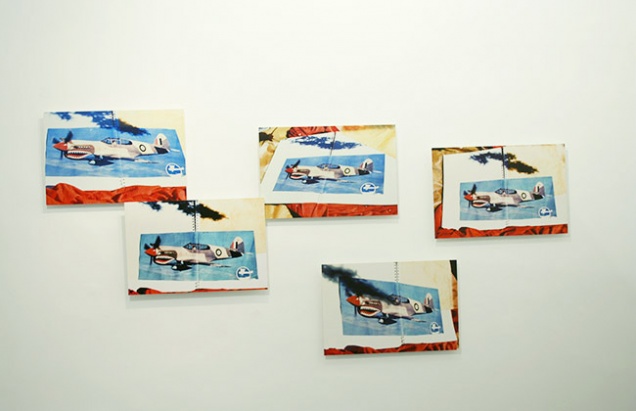
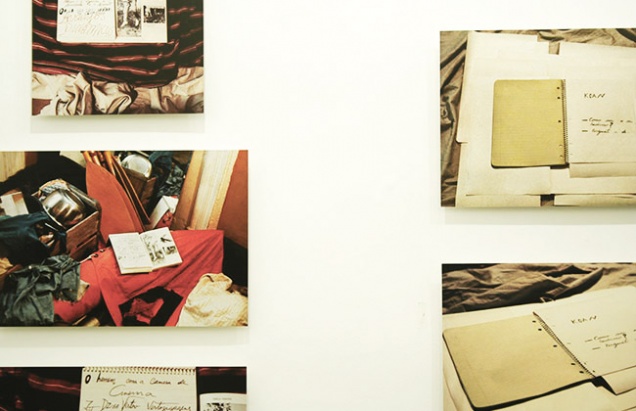
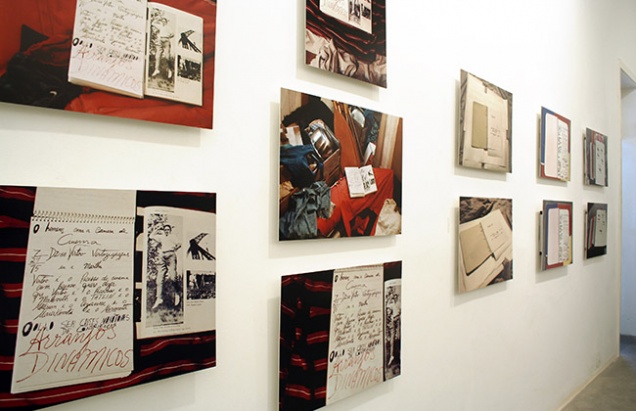
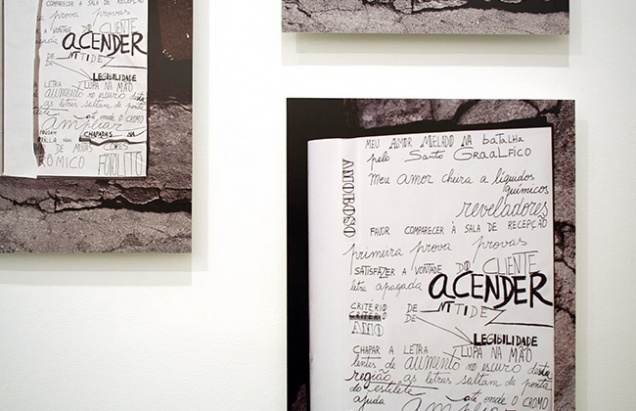
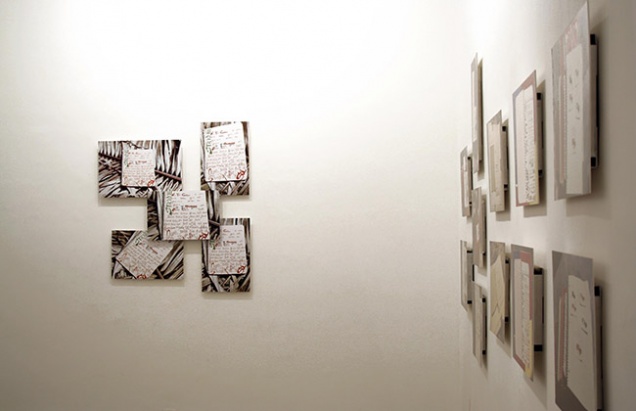
We are, therefore, dealing with a compound form of expression that involves an inter-relationship between various arts, achieved through the photography of spatialised words; semantic constructions and deconstructions; ideograms; handwritten texts; montages; drawings and collages in particular angles and lighting, all of them executed in lined spiral notebooks of various formats meant to be taken as structural values. On one hand, the lined spiral notebooks are elementary, simple, everyday objects; on the other hand, they are the supports for an extremely bold and highly sophisticated visual-poetic proposition ? a mise-en-scène constructed even as the poet prepares camera set ups for his writing of objects that they may configure multiple readings and meanings.
Formal values such as colour, plane, light, space and time co-exist with the spontaneous gestural shapes of a number of different versions of his calligraphy, inserted in collages of printed images, objects and environments. Nearly always operated by Marta Braga, the camera frames the notebooks in specific, often unusual situations in open air or as part of environments especially assembled that the snapshot might capture the visual-kinetic game. Notebooks may be seen resting upon sidewalks in various cities; upon floors; upon grass; upon stone surfaces; upon clothes; upon palm straw; upon bed sheets; upon oars; in sunlight; or even upon one another, in layers, as in the CALTDERNARO and ALTDUPLICADERNARO notebooks.
As revealed in 35 mm slides, the photographs ? some of which Waly published in poetry magazines or projected at events that were always enhanced by his eloquent readings ? are arranged in specifically titled groups. Often, the titles themselves give final form to the group of images, as is the case with KOAN, CHEAP MONDRIAN, CONSTRUCTIVIST HICK, BRASILLY and AMALGAMICS. Yet it was always, as the poet insisted on reiterating, a ?polysemic? operation ? a personal mix of signs, idioms and languages; fused in an exercise of images about images.
Waly aptly distinguishes his work from so-called visual poetry, a separate category and a variant of conceptual art, one which attempted ? during the same decade in which the Babilaques were made ? to overcome the conflicts of the modernist vanguards as expressed in minimal art, performance art, body art, earth works, and land art, among other manifestations.
***
I believe that, in order to understand this aspect of Waly Salomão?s work in greater detail, one must recall certain moments of his trajectory as a poet, including his education in the heat of the Bahia avant-gardes of the early 1960s and the first texts he wrote in Rio de Janeiro and São Paulo.
During the years in which he studied Law and theatre arts in Bahia, and became involved in the political student movement, Waly participated in the exceptional period of cultural and institutional modernization of the country?s arts and sciences. From 1958 to 1964, the vanguards ?of the visual arts, of experimental music, of dance, of theatre, of film, of museology, of anthropology and of education? not only formed a nucleus of possible interaction between the arts, but also kicked off a pioneering experiment in cultural decentralization that reacted to the Rio de Janeiro?São Paulo axis; it certainly affected talented artists who, like Waly Salomão, had been educated in the provinces, and served as a cornerstone for the articulation of new ideas and cultural positions. Over the next few years, they would be forced come to terms with the grave social conflicts generated by the survival of free expression - seriously curtailed as it was by the military takeover.
In other words, from 1970 on, Brazilian cultural life would be made up of an abundant and rather complicated mesh of values that ambiguously limited and enriched the legacy of the great artistic and ideological accomplishments that took place during the 1950s and 1960s. Practically every one of these accomplishments was directly linked to the support of the political and cultural left that that led, above all in the Brazilian capital and in neighbouring states, the country?s principal cultural institutions, among which universities, museums, newspapers and publishing companies.
One of the most important examples of this support was given by the Neo-Concrete Movement (1959?1960), whose artists were not (and had never been) leftist militants, but whose overall project was supported and disseminated by the left?s most serious cultural articulators. Said support and dissemination were so striking that it now seems only fitting to inquire whether the fate of those artists might have turned out the way it did had it been unaccompanied by the participation ? without precedent in the history of Brazilian journalism? of the Suplemento Dominical do Jornal do Brasil [Jornal do Brasil Sunday supplement].
It should be mentioned that, during this period, a range of political influences were reflected in the seven most important daily newspapers in circulation in Rio de Janeiro, to wit: the Jornal do Brasil, the Diário de Notícias, the Correio da Manhã, O Globo, Última Hora, the Tribuna da Imprensa and O Dia, every one of which featured art, film, drama, music and literary sections and reviews in which the likes of Mario Pedrosa, Ferreira Gullar, Reynaldo Jardim, Oliveira Bastos, José Guilherme Merquior, Roberto Pontual, José Lino Grünevald, Paulo Francis and Millôr Fernandes provided regular coverage of the city?s cultural scene.
***
The generation that would soon make up what subsequently became known as the counterculture inherited the enfeeblement that affected the cultural left, which is to say that they did not know how to absorb the new theatre, the new music, the new poetry, the new ideas and the new manifestations of popular music (around which the most heated debates took place during the height of Tropicalismo circa 1967).
The exhibition organized by artist Carlos Vergara at Rio de Janeiro?s Museu de Arte Moderna in 1971 (curiously titled Exposição, - the Portuguese word for ?exhibition?) was a highly significant moment in Waly Salomão?s relationship with the visual arts - an experimental event that included work by artists who had never participated in art exhibitions. Waly exhibited a single work, one which contained a photograph by Bina Fonyat ? a visual poem in which the open palm of his hand is spread across typical souvenirs of Rio (plates painted with images of parrots, butterfly wings, palm trees, the Sugar Loaf and Christ the Redeemer ? the Corcovado), and upon it a short, stylistically ?Oswaldian? phrase: ?I know Rio de Janeiro like the palm of my hand,/ the lines of which I do not know?.
Thus, the artist began exploring the possibilities of visual and experimental poems with words and objects. His partnership with me and with Oscar Ramos belongs to this period (1971?1972). Together, we created environmental pieces using outsize lettering, including the highlighted words -FA-TAL- and VIOLETO that made up the backdrop for [singer] Gal Costa?s epochal Gal a todo vapor [Gal Full Steam] concert, and the poem ?ALFA ALFAVELA VILLE?, for which we created giant letters to be used in a collective performance by young artists on Copacabana beach. Ivan Cardoso photographed that performance for the magazine Navilouca, (published shortly thereafter by Waly and [poet] Torquato Neto). During this period, he and [journalist] José Simão shot the unfinished film Alfa Alfavela Ville in a few of Rio?s favelas (or shanty towns). The film is being screened at this exhibition for the first time.
***
What, then, were the artistic choices on Waly Salomão?s oblique and un-programmed trajectory? What are the formative elements in his repertory of finely selected art, painting, sculpture, film, ideas and thoughts, which he elected as fundamental affinities?
To get to the core of his artistic persona, it is possible to track the sublime lyricism of the drawings and paintings of Paul Klee; the abstractions of Wassily Kandinsky; the calligramme poems of Guillaume Apollinaire; the reliefs, poetry and organic forms of Jean Arp; the assemblages and boxes of Kurt Schwitters; the paintings and poems of Francis Picabia; the works of Piet Mondrian, Marcel Duchamp, Alexander Rodchenko, Laszlo Moholy-Nagy, Man Ray, Dziga Vertov, Sergei Eisenstein, Bertolt Brecht and Jean-Luc Godard; the vanguards of Brazil; everything, in short, that aspired to or led to the autonomy of art in the twentieth century and stimulated (albeit not in formal or even stylistic terms) poetic expression and free experimentation that gave rise to the Babilaques.
Unlike concrete poetry?s visuality or its postulates and programs, the Babilaques are inclined to affirm subjectivity, life and an individual artistic ideological repertory that is established by freely embracing the idea of interaction between the arts. Something quite close to the experimental direction adopted by Brazilian art since the Neo-Concrete Movement, with which Waly Salomão maintained a close dialogue, in particular with Hélio Oiticica, who was one of the earliest, most enthusiastic readers of the manuscript that, in 1972, would become the book Me segura qu?eu vou dar um troço.
Waly quickly grasped the complexity of the artistic and ideological conflicts that had signalled the conceptual split between Concrete and Neo-Cconcrete, and drew qualities from both movements without ever becoming bogged down by the sort of paternities or reverential attitudes that sometimes inhibit individual expression. His editorial partnership with Torquato Neto in the magazine Navilouca was a moment of synthesis for the views of a group of poets and artists who were placing all their bets on the publication as a breathing space, a means to overcoming the ideological conflicts that befell all artistic expression during that period. How else ought we to understand Haroldo de Campos? dictum to the effect that: ?one also arrives at Mondrian by way of the butcher?s shop??
Waly Salomão?s many notebooks of writings, spellings and drawings are not manuscripts translatable into ordered type to be laid out on pages of printed text. Rather, they are poetic objects crafted without formal influence from his artistic repertory. Thus, they do not encourage cults or fetishes of the ?artist?s notebook? or ?behind the scenes? varieties, as it were.
The Babilaques began when he moved to New York, leaving behind the weight of the ideological conflicts he had been made to deal with in Brazil. It was in the North American metropolis that he found the means to undertake what he had so lyrically heralded in the ?The Beauty and the Beast? chapter of Me segura qu?eu vou dar um troço: the KLEEMINGS ideogram (i.e., Paul Klee + E. E. Cummings = ?clean[s]ing moment? ? quite literally, another moment ?within the sphere of self-production?; now wholly through art and poetry.
Luciano Figueiredo