

Lygia Clark
LYGIA CLARK
Belo Horizonte, 1920-1988
Lygia Clark began her artistic training with Roberto Burle Marx in Rio de Janeiro in 1947. From 1950 to 1952 she lived in Paris, where she studied with Fernand Léger, Arpad Szenes, and Isaac Dobrinsky. On her return to Brazil, she joined the Grupo Frente and later became a founder of the Neo-Concrete movement together with Hélio Oiticica, Lygia Pape, and others, taking part in the 1959 inaugural exhibition. She gradually moved her focus from painting to three-dimensional objects, executing interactive works such as the series Bichos in 1960. After teaching at the Sorbonne in Paris from 1972 to 1976, she returned to Brazil and turned her attention to the therapeutic possibilities of sensory art and relationship objects. By the 1980s, her work enjoyed international prominence and was featured at the Venice Biennale (1960, 1962, 1968), the São Paulo Biennial (several years), Documenta in Kassel, Germany (1997), and the Instanbul Biennial (2001). Lygia Clark passed away in 1988. Since then, her works have been exhibited at major museums such as the Los Angeles MoCA, the Centre Pompidou in Paris, and the Solomon R. Guggenheim Museum and MoMA, in New York.
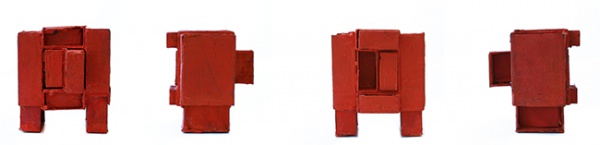
Matchbox sculptures 1964 | Red gouache, matchboxes, glue | 7 x 6,5 x 7,5 cm
©2016 LURIXS : Arte Contemporânea. 214 Dias Ferreira St - Rio de Janeiro RJ Brazil
Developed by New Gosling